

From the start of the 2025–2026 academic year, the École du Louvre will be offering a brand-new course on Jewish arts and archaeology, thanks to the support of the Fondation Etrillard.
The Fondation Etrillard has entered into a six-year partnership to fund this new specialist chair, with courses open to undergraduate students and non-degree students.

The École du Louvre offers its undergraduate students and external students the opportunity to follow courses organised into ‘specialist departments’, designed to provide in-depth study of a specific field over three years. Until now, there were thirty-one such specialist departments.
The thirty-second specialism course, on Jewish arts and archaeology, serves a dual purpose: on the one hand, to raise awareness of and foster an appreciation for the work of archaeologists and art historians, public collections and, more broadly, the heritage of the Jewish world in all its diversity from antiquity to the present day. Secondly, to train future specialists in the Judaica collections of French museums – which are little known and still often poorly studied – and in the rich architectural heritage of Judaism.
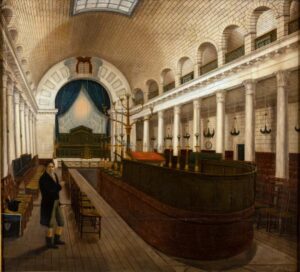
This new specialist course is aimed at undergraduate students at the École du Louvre and takes the form of a core module, a synthesis module and practical work. The core module is unique in that it is also open to non-degree students.
The core module, led by Dominique Jarassé, is entitled ‘An Art Without Territory? Synagogues: An Architecture of Jewish Identity. This course, lasting a total of 20 hours, is directly linked to current research.
The synthesis course, structured as a three-year cycle (with 20 hours of teaching per year), covers various fields (archaeology, Judaica, built heritage). It will be taught from the start of the 2025 academic year by Paul Salmona and focuses on the archaeology of ancient and medieval Judaism.
Finally, the practical sessions, whose programme is closely linked to the core course, are led by Anaëlle Gobinet-Choukroune. These sessions aim to facilitate the assimilation of knowledge and to develop the methodology applied to the chosen specialism.
The selection of lecturers was carried out by the management and the academic directorate of the École du Louvre, in consultation with the management of the Museum of Jewish Art and History.
The proposal to establish a chair dedicated to the arts and archaeology of Judaism is fully in line with the Fondation Etrillard’s mission, as it works to highlight and promote the significance of cultural heritage – particularly European heritage – in the contemporary world. By fostering and supporting academic research, the aim is to promote the transmission of knowledge, the rediscovery and the preservation of heritage and works linked to Jewish history and culture.
The Foundation is honoured to contribute to a field of knowledge that is fundamental to the understanding of history and art history – a field for which there is currently no university chair in France, unlike in some of our European neighbours.
“We felt this chair was essential, as it fills a gap between the existing specialisms in Islamic art and the art of Eastern Christians. We hope that many students and auditors will enrol on the course,” said Miguel Perez de Guzman, General Delegate of the Fondation Etrillard.
The Etrillard Foundation also supports the École du Louvre through the ‘Arts of the Past / Arts of the Present’ doctoral research grant, as well as living grants to help students in financial difficulty.
To register as an auditor for the ‘Arts and Archaeology of Judaism’ course, click on this link: www.ecoledulouvre.fr