

The Fondation Etrillard is collaborating with the Kunsthaus Zurich as part of the exhibition “Vilhelm Hammershøi. The Eye That Listens”, from 3 July to 25 October 2026.
The Kunsthaus Zurich is showcasing the work of Vilhelm Hammershøi (1864–1916). Featuring more than fifty paintings by the Danish artist, this exceptional retrospective offers an insight into the painter’s world. Through his silent interiors, diffused lighting and infinitely subtle nuances, he created an enigmatic and profoundly unique oeuvre. Although still relatively unknown, it is now regarded as one of the most fascinating examples of European modern art.
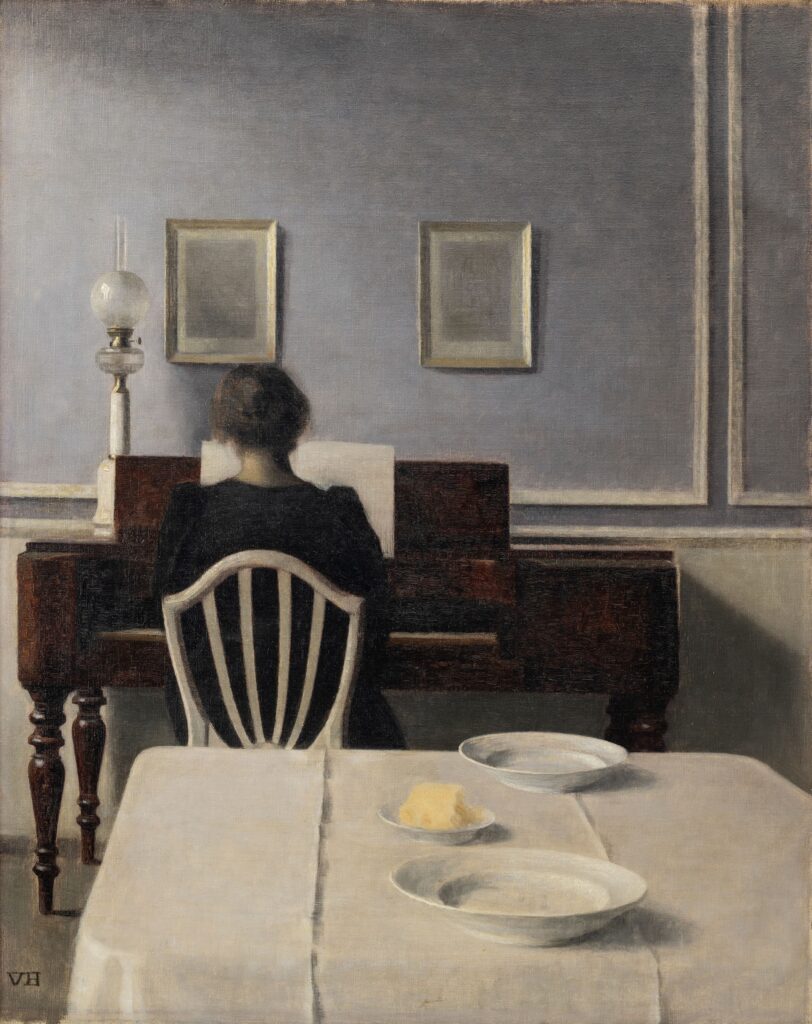
Nicknamed the ‘Vermeer of the North’, Vilhelm Hammershøi incessantly painted quiet interiors where time seems to have stood still. Among the motifs he frequently depicted were his wife Ida, usually shown from behind in their Copenhagen flat – as was already customary during the Romantic period – and the window. This element, which lends structure to the composition, offers Hammershøi the opportunity to create interplay between the interior and the exterior: he subverts the window’s primary function, which is to allow a view of the outside. The windows in his paintings are, in fact, opaque and deprive the viewer of what is happening on the other side. Nevertheless, the panes filter the rays of light, casting shadows onto the interior spaces and creating subtle shades of colour.
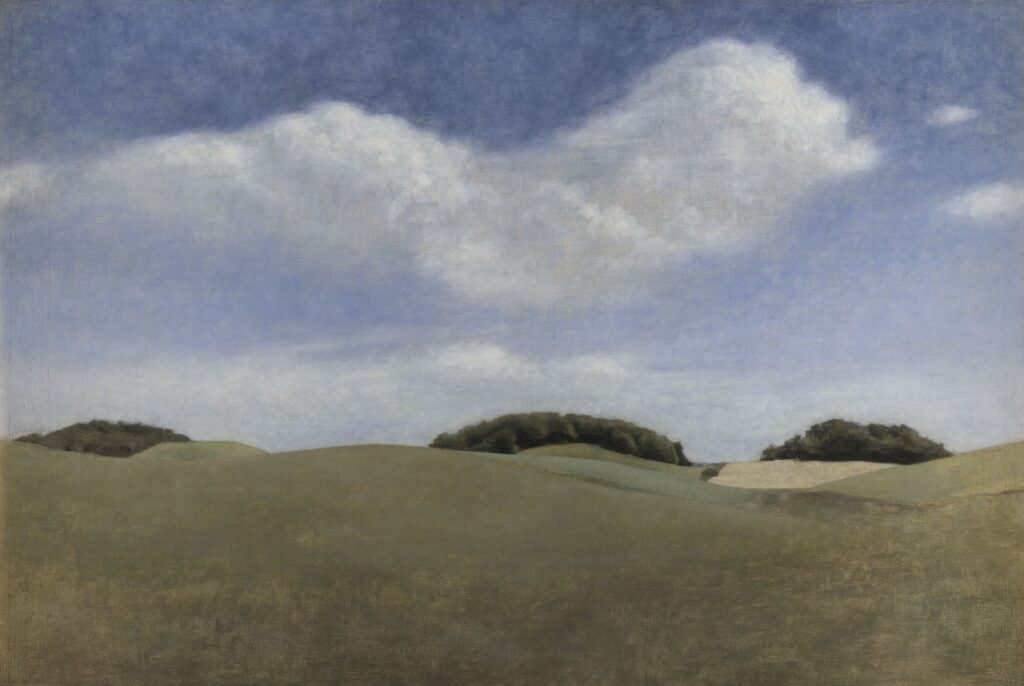
In addition to his interior scenes, Vilhelm Hammershøi also produced paintings of rural settings and outdoor landscapes. Depicted in the same style as his interior scenes, these uninhabited rural landscapes emphasise the calm and the silence of nature. Though absent at first glance, the human presence is revealed discreetly through smoke rising from a chimney or a road in the distance. With trees and hills lending rhythm to the compositions, these landscapes are bathed in a dreamlike atmosphere, created by the subtle shades of colour that form a unique veil of light. Portrayed as silent spaces, both his interiors and landscapes invite contemplation and reflection.
Published in German and English, the exhibition catalogue is supported by the Fondation Etrillard. As they turn the pages, readers are immersed in an enigmatic world where speculation reigns, as Vilhelm Hammershøi left very little information about his work and even burnt his correspondence. An elusive painter, whose work transcends the ages in a silence imbued with presence.
The Etrillard Foundation is a patron of the exhibition “The Seduction of Color. Andrea Solario and the Renaissance between Italy and France” at the Museo Poldi Pezzoli in Milan.
Presented from March 26 to June 30, 2025, this exhibition invites visitors to rediscover the genius of the Lombard Renaissance master Andrea Solario (1465-1524), on the occasion of the 500th anniversary of his death. The Museo Poldi Pezzoli will host exceptional works from prestigious international collections, with the scientific collaboration of the Louvre Museum.
Andrea Solario, “Rest on the Flight into Egypt”, 1515, Milan, Museo Poldi Pezzoli (detail)
The exhibition brings together for the first time a selection of approximately 36 works from prestigious collections in Italy, France, and England.
These masterpieces reveal the technical mastery and stylistic evolution of an artist influenced by great masters such as Giovanni Bellini, Antonello da Messina, and Leonardo da Vinci.
Andrea Solario, “Portrait of Charles d'Amboise, Marshal of France, Governor of Milan in 1500 and Patron of Painters”, circa 1510-1511, Paris, Louvre Museum, © GrandPalaisRmn (Louvre Museum) / Franck Raux (detail)
This project highlights the importance of color in Solario’s art, and reveals how his style was nourished by Franco-Italian cultural interaction.
The Museo Poldi Pezzoli conducted important scientific analyses to better understand the master’s pigments, materials, and techniques. The paintings were subjected to X-rays, reflectography, and infrared analyses that revealed previously unknown details. These studies were compared with those conducted by the Center for Research and Restoration of the Museums of France, offering new interpretations on the use of chiaroscuro and the enameled colors typical of the artist.
Concurrently, six works were restored: five in Milan, including the Portrait of a Lady at the Castello Sforzesco, and one at the Louvre, where the Madonna of the Green Cushion regained its original luminosity.
Andrea Solario, “Madonna Nursing the Child (Madonna of the Green Cushion)”, circa 1510, Paris, Louvre Museum © GrandPalaisRmn (Louvre Museum) / Michel Urtado (detail)
The Museo Poldi Pezzoli, opened in 1881, was the home of Gian Giacomo Poldi Pezzoli (1822-1879), an impassioned collector of paintings, sculptures, carpets, lace, arms and armor, and jewelry. An extraordinary collection enriched over time by major acquisitions and donations.
The museum houses masterpieces by Pollaiuolo, Mantegna, Botticelli, Raphael, Piero della Francesca, Tiepolo, Canaletto, and Hayez. In addition, it preserves astonishing collections of Murano glass, porcelain, sundials, and clocks.
The Museo Poldi Pezzoli is thus one of the most renowned house-museums, firmly rooted in the Milanese cultural landscape.
The Etrillard Foundation is pleased to establish its first partnership with the École Nationale des Chartes – PSL, a bicentennial benchmark institution for training archivists, researchers, and curators of heritage, museums, and libraries.
The two institutions have jointly created the “Etrillard Foundation Thesis Prize” to reward a student’s research work on a theme dear to the Foundation, such as the rediscovery of little-known knowledge, bringing to light a chapter of European history, or the continuity between the arts of the past and the arts of the present.
The School thesis consists of scientific research work carried out by the student over the last three years of their archivist-paleographer curriculum; defended before a scientific jury, it validates their diploma.
A call for applications was issued to students of the École Nationale des Chartes – PSL from January to February 2025.
A jury composed of members of the Etrillard Foundation and the School will select several subjects from among the candidate theses of the current year.
Following examination and the jury’s decision committee, a laureate will be awarded the Etrillard Foundation Thesis Prize, endowed with 8,000 euros, during a ceremony in June 2025.
Founded in 1821, the École Nationale des Chartes – PSL is a major higher education and research establishment.
A component institution of the world-class Paris Sciences et Lettres (PSL) University, it is a reference institution for the training of researchers, archivists, and library and heritage curators. Its high-level teaching is oriented toward the analysis of documents of all kinds (archaeological materials, books, writings, artworks, audiovisual and electronic media, etc.) as well as the associated digital technologies.
The mission of the Fondation de l’École des Chartes – PSL is to support and promote the teaching and research of the School and its partners.
Starting in the 2025-2026 academic year, the École du Louvre will offer enrollment in a brand-new course on the arts and archaeology of Judaism, thanks to the support of the Etrillard Foundation.
The Etrillard Foundation has indeed concluded a six-year partnership to fund this new specialized chair, whose classes will be open to undergraduate students and auditors.
The École du Louvre offers its undergraduate students and auditors courses organized into “specialized chairs”, designed to deepen knowledge in a specific field over three years. Until now, there were thirty-one of these specialized chairs.
The thirty-second specialized course, focusing on the arts and archaeology of Judaism, fulfills a dual purpose: first, to raise awareness and appreciation of the results of work by archaeologists and art historians, public collections, and more broadly, the heritage of Jewish worlds, in all their diversity from Antiquity to the present day. Second, to train future specialists for the Judaica collections in French museums, which are little known and often still poorly studied, and for the rich architectural heritage of Judaism.
This new specialized chair is designed for undergraduate students at the École du Louvre and is structured around an organic course, a synthesis course, and practical tutorials. The organic course has the distinction of also being open to auditors.
The organic course entrusted to Dominique Jarassé is entitled “An Art Without Territory? Synagogues, an Architecture of Jewish Identity”. This 20-hour course is directly linked to current research.
The synthesis course, structured cyclically over three years (at a rate of 20 hours per year), covers various fields (archaeology, Judaica, built heritage). It will be taught starting in the fall of 2025 by Paul Salmona and focuses on the archaeology of ancient and medieval Judaism.
Finally, the practical tutorials, whose syllabus is closely aligned with the organic course, are taught by Anaëlle Gobinet-Choukroune. These classes aim to facilitate the assimilation of knowledge and to develop the methodology applied to the chosen specialty.
The selection of teachers was carried out by the management and the department of studies of the École du Louvre, in conjunction with the management of the Museum of Jewish Art and History.
The project to create a chair dedicated to the arts and archaeology of Judaism is fully in line with the Etrillard Foundation’s mission, as it strives to reveal and promote the relevance of cultural heritage, particularly European, in the contemporary world. By encouraging and supporting academic research, the aim is to foster the transmission of knowledge and the rediscovery and preservation of heritage and works related to Jewish history and culture.
The Foundation is honored to contribute to a field of knowledge that is fundamental to the understanding of history and art history, a field that currently has no higher education chair in France, unlike in some of our European neighbors.
“This chair appeared essential to us, as it fills a gap between the existing specializations in Islamic art and the art of Eastern Christians. We hope that many students and auditors will enroll in it,” states Miguel Perez de Guzman, General Delegate of the Etrillard Foundation.
The Etrillard Foundation also supports the École du Louvre via the “Arts of the Past / Arts of the Present” Doctoral Research Fellowship, as well as living grants to assist students in precarious situations.
To enroll in the Arts and Archaeology of Judaism classes as an auditor, click on this link: www.ecoledulouvre.fr
An iconic painter of the 18th century
The Fondation Etrillard is partnering with the Petit Palais, Musée des Beaux-Arts de la Ville de Paris, to support its exhibition Jean-Baptiste Greuze. Childhood illuminated, from 16 September 2025 to 25 January 2026.
The Petit Palais pays tribute to Jean-Baptiste Greuze (1725-1805) on the occasion of the 300th anniversary of his birth. A painter of the human spirit, famous for his portraits and genre scenes, Greuze was one of the most important and daring figures of the 18th century. Although he is less well known today, in his own time, he was acclaimed by the public, courted by collectors, and adored by critics, Diderot in particular. He was, however, also utterly singular. A rebellious spirit, he never ceased to reaffirm his creative freedom and the possibility of rethinking painting outside of conventions.
Painting childhood
Rarely did a painter depicted children as frequently as Greuze, whether in the form of portraits, expressive head studies, or genre scenes, whether candid or naughty, mischievous or sulking, in love or cruel, focused or pensive, adrift in the world of adults, loved, ignored, punished, embraced, or abandoned. Like a recurring motif, children are everywhere, at times asleep in a mother’s arms, at times lost in a melancholic reverie, or occasionally seized by the fear of an event beyond their control. In this exhibition, this particular stage of life is examined over the course of seven different sections, from early childhood to the beginnings of adulthood.
The centrality of the theme of childhood in Greuze’s painting can be said to reflect the key issues of the 18th century. Childhood was now considered an age in its own right. The debates over breastfeeding versus the use of wet nurses, a child’s place within the family, the importance of education in forging a child’s personality, were main concerns of educators and philosophers of his time.
International loans and a prestigious curatorship
This exhibition allows visitors to rediscover his work through approximately one hundred works of art, on loan from some of the most important French and international collections, including the Musée du Louvre (Paris), Musée Fabre (Montpellier), Metropolitan Museum of Art (New York), Rijksmuseum (Amsterdam), National Galleries of Scotland (Edinburgh), the Royal Collection (Britain), as well as numerous private collections.
The exhibition was curated by Annick Lemoine, Chief Heritage Curator and Director of the Petit Palais, Yuriko Jackall, Department Head of European Art and the «Elizabeth and
Allan Shelden» Curator of European Painting, Detroit Institute of Arts, and Mickaël Szanto, Associate Professor, Sorbonne Université.
Support from the Fondation Etrillard
As part of its arts patronage programme, the Fondation Etrillard supports the rediscovery of works, artists and artistic movements that are little known to the general public. The exhibition Jean-Baptiste Greuze. Childhood illuminated showcases a major 18th-century painter and his bold approach to depicting the intimate family sphere.
With the same aim of rediscovery, the Foundation has supported the exhibitions: The Seduction of Colour. Andrea Solario and the Renaissance between Italy and France at Museo Poldi Pezzoli in Milan (2025), Figures of the fool, From the Middle Ages to the Romantics at the Louvre (2024-25), Harriet Backer. The music of color (2024-25) as well as Louis Janmot. The Poem of the Soul (2023-24), both at the Musée d’Orsay in Paris.
Find out more about the exhibition: www.petitpalais.paris.fr/en
The Petit Palais
Built for the 1900 Universal Exhibition, the Petit Palais is nestled in the heart of Paris’s Golden Triangle. It offers a rich panorama of artistic creation, spanning from antiquity to the early 20th century. The museum is particularly renowned for its collection of Greek vases, Renaissance objets d’art, Dutch paintings, and 19th-century French masterpieces by artists such as Géricault, Courbet, and Cézanne.
An architectural gem of the Belle Époque, the Petit Palais hosts major international exhibitions each year. Recent highlights include Modern Paris, 1905-1925, which attracted 278,702 visitors; Sarah Bernhardt. And the woman created the star in 2023; Boldini. Pleasures and Days in 2022, which welcomed 116,200 visitors; and Ilya Répine (1844-1930). Painting the soul of Russia.
The ambition of La Cité Bleue is to promote the creation of shows that bring together the greatest artists in music, theatre, dance, the visual arts and the circus. Under the direction of the Swiss-Argentinian harpsichordist and conductor Leonardo García Alarcón, La Cité Bleue offers pocket operas, chamber music recitals, musical theatre, educational activities and hybrid forms in an innovative approach to these disciplines.
After years of closure for renovations, La Cité Bleue inaugurated its new, completely renovated auditorium in Geneva on 9 March 2024, equipped with acoustic technology that is unique in Switzerland. The Fondation Etrillard is taking part in the inaugural season as patron of the concert Amour à mort.
Taking up the story of Tancredi and Clorinda from Torquato Tasso’s 16th century poem Jerusalem Delivered, “Amour à mort” (Deadly Love) lies
halfway between madrigal, opera and interlude. Bringing together a series of pieces by Claudio Monteverdi and other composers from the Renaissance and Baroque eras, the music sets the pace for the on-stage action in which actors, musicians and singers perform all together.
Thanks to Jean-Yves Ruf’s masterful staging and Leonardo García Alarcón’s brilliant musical direction, “Amour à mort” brings to life a moving story of love and tragic death.
Tancredi spots a Moorish woman by a waterhole. He immediately falls in love with her. Her name is Clorinda and she is a formidable warrior. He seeks her out at every battle, even trying to protect her, until one day Clorinda changes her armour, wanting to go unnoticed. Tancredi does not recognise her and wounds her to death, thinking he is fighting an unknown warrior.
The Fondation Etrillard has four tapestries in its collection illustrating the story of The Liberation of Jerusalem. To echo the plot of the show, the Foundation has made available to La Cité Bleue very high quality digitisations of two of these tapestries, as well as a series of three videos explaining these 17th century works.
Thanks to this content and the support of the Fondation Etrillard, La Cité Bleue is offering its visitors an outreach programme around the tapestries on the touch table in the entrance hall, accessible to all visitors, especially young people. It’s a fun way to extend the concert experience, combining music and art history.
For the past three years, the Museum of Art and History of Geneva (MAH) has organized XL “carte blanche” exhibitions, which allow internationally renowned artists to take over the MAH’s collection and occupy its rooms by giving free rein to their creativity.
During the first six months of the year, the museum’s spaces are transformed through the eyes of an external curator who addresses various subjects in a way that is as specialized as it is accessible. This approach allows the MAH collections to be understood in an original way, and the visitor to rediscover works that emerge from storage.
Following Jakob Lena Knebl (2021), Jean-Hubert Martin (2022) and then Ugo Rondinone (2023), it is now Wim Delvoye’s turn to curate the XL 2024 exhibition.
This exhibition “The Order of Things: Carte Blanche for Wim Delvoye” runs from January 26 to June 26, 2024. The Belgian visual artist, born in 1965, offers a unique artistic and aesthetic experience and a deep exploration of our relationship with art and the objects that surround us. As an artist passionate about things and artifacts, whether they are recognized works or simple objects, Wim Delvoye invites us to question the seemingly overly rigid boundaries separating art objects from everyday ones. Thus, pieces from the museum’s collection enter into a play of reflections and contrasts with those of Wim Delvoye.
Left: Frank Christian, Nautilus Cup and its case, circa 1680 © Museum of Art and History of Geneva, photo B. Jacot-Descombes; right: Wim Delvoye, Case for a Moped, 2004 © Claudine and Jean-Marc Salomon Collection.
There is no imposed route here. The public is invited to immerse themselves in a joyful and playful abundance of objects, references, and interventions proposed by the Flemish creator in the name of what he himself calls “elegant vandalism.”
In this profusion, it is nevertheless possible to follow a few paths. First, diversion, which consists of stealing an object from its original context and transplanting it into another realm of reality. Thus, a Picasso becomes an obstacle that a giant marble run playfully pierces; cases converse with sarcophagi. Then there are reversals, whether conceptual or physical. The noble becomes trivial, and vice versa; for example, when Wim Delvoye gives a case an importance and splendor that one would rather expect from its contents, thereby questioning our aesthetic hierarchies. Finally, the various juxtapositions give rise to a reflection on the very notion of a collection, on the limits and the beauties of the accumulative gesture.
Left: Wim Delvoye, Nautilus, 2017; right: Wim Delvoye, Rimowa Classic Flight Multiwheel © Studio Wim Delvoye
The Order of Things thus perfectly aligns with the mission of the Fondation Etrillard: this artist playfully creates bridges between the artifacts of the collections of the Museum of Art and History and his own contemporary creations. These dialogues create surprise as much as they probe our relationship with heritage: an approach dear to the Fondation Etrillard.
Antonio Canova, Venus “Italica” or Venus Emerging from the Bath, 1807-1810 © Museum of Art and History of Geneva, photo B. Jacot-Descombes; right: Wim Delvoye, Ball Track Venus Italica, 2023 © Studio Wim Delvoye
Following Louis Janmot: The Poem of the Soul in 2023, the Fondation Etrillard is once again supporting a Musée d’Orsay exhibition showcasing the work of a little-known 19th-century painter.
Although celebrated during her lifetime and undeniably talented, Harriet Backer had fallen into relative obscurity outside the borders of her home country, Norway. This rich retrospective, the first exhibition dedicated to this artist in France, finally restores her to her rightful place.
In partnership with major Norwegian art institutions, it will run from September 24, 2024, to January 12, 2025.
Harriet Backer, “Evening, Interior [Aften, interiør]”, 1896, Oslo, National Museum, © National Museum / Børre Høstland
Little-known outside her native country, Harriet Backer was the most renowned female painter in Norway at the end of the 19th century. She achieved a highly personal synthesis of interior scenes and plein-air painting, drawing inspiration from both the realist movement and the innovations of Impressionism through free brushwork, a brightening palette, and a deep interest in the variations of light. While Backer’s painting evolved significantly from a stylistic point of view over her long career, she remained faithful to a limited number of subjects and direct study from life.
Harriet Backer, “My Studio”, 1918, Bergen, Kode Bergen Art Museum, © Kode / Dag Fosse
Sister to a renowned composer, Agathe Backer Grøndahl, she placed music at the heart of her work, both as a subject and as a model.
Like many bourgeois women, Backer mastered the piano, and it held pride of place in her apartments in Paris and Kristiania (Oslo). The theme of the woman at the piano permeates Backer’s work throughout her career.
More than just a theme, music was a model for Backer: she wanted the painting to be “music for the eye”. Like many artists of her time, she saw music as the aspiration and model for all art. Through brushwork, composition, and color, she created rhythms and colorful harmonies that translate the impressions produced by music.
Harriet Backer, “At the Piano [Ved pianoet]”, 1894, Oslo, National Museum, © National Museum / Børre Høstland
Returning to Norway in the early 1890s after training in the major European art capitals of Munich and Paris, Harriet Backer opened a mixed painting school, which was exceptional for the time. This studio became one of the most important in the country before the creation of the Academy of Fine Arts. This teaching supplemented her income because she painted so slowly that she could not live solely from the sale of her paintings. As a teacher, she encouraged everyone to develop their own style. Backer had a considerable influence on a whole younger generation of Norwegian artists.
Serving on numerous exhibition juries, Backer was also, for twenty years, a member of the board of directors and the acquisition committee of the National Gallery of Norway.
Harriet Backer, “Jonasberget Farm [Jonasberget]”, 1892, Bergen, Kode Bergen Art Museum © Kode / Dag Fosse
Following the exhibition Things: A History of Still Life in 2022-2023 and The Treasure of Notre-Dame de Paris in 2023-2024, the Fondation Etrillard is renewing its support for the Louvre Museum for an ambitious and stimulating exhibition: Figures of the Fool: From the Middle Ages to the Romantics, presented from October 16, 2024, to February 3, 2025, in the Hall Napoléon.
After Hieronymus Bosch, “The Concert in the Egg”, © GrandPalaisRmn (Palais des Beaux-Arts, Lille) / Stéphane Maréchalle
The exhibition will explore the fascinating figure of the fool: while this figure was an integral part of the visual culture of people in the Middle Ages, it has rarely been explored from the perspective of art history. Yet between the 13th and mid-16th centuries, the notion of madness inspired and stimulated artistic creation, both in the fields of literature and the visual arts.
The Fondation Etrillard is therefore delighted to contribute to the rediscovery of the subversive and quintessentially medieval figure of the fool, through a chronological and thematic journey of over 300 works: sculptures, objets d’art, medals, illuminated manuscripts, drawings, engravings, paintings, and tapestries.
The exhibition is curated by two curators from the Louvre Museum: Elisabeth Antoine-König (Department of Objets d’Art) and Pierre-Yves Le Pogam (Department of Sculptures).
This exhibition is in line with the mission to rediscover the Middle Ages, dear to the Fondation Etrillard, which it carries out in various fields of art and humanities, in Switzerland as well as in France. This goal is notably reflected in the sponsorship of exhibitions related to the Middle Ages (illuminated manuscripts from Switzerland at the Bodmer Foundation, the Treasure of Notre-Dame at the Louvre, Charles VII at the Musée de Cluny).
For this support, the Fondation Etrillard is pleased to associate once again with the New York Medieval Society, the Foundation’s American partner, with whom it collaborated for the exhibition The Arts in France under Charles VII (1422-1461) at the Musée de Cluny.
Jan Matejko, “Stańczyk during a ball at the court of Queen Bona in the face of the loss of Smolensk”, Warsaw, Muzeum Narodowe w Warszawie/Piotr Ligier
The Cluny Museum – National Museum of the Middle Ages, which reopened its doors in May 2022 after several years of renovation, will present from March 12 to June 16, 2024, in partnership with the GrandPalaisRmn and with the exceptional collaboration of the Bibliothèque nationale de France, an exhibition dedicated to the renewal of the arts in France during the time of Charles VII.
This will be the Cluny Museum’s major exhibition in 2024, unfolding in the Frigidarium room (remains of the Roman baths of Lutetia, 1st-2nd centuries).
The reign of Charles VII, specifically the years 1420-1460, represents a pivotal moment in the history and art history of France and Europe. Indeed, from the 1430s onwards, the kingdom underwent profound political and artistic transformations. While the north of the country was occupied by the English and the Burgundians, multiple artistic centers emerged (Anjou, Poitou, Touraine, Berry, Toulouse area…). The epic of Joan of Arc and the reconquest undertaken by Charles VII heralded the end of the endless Hundred Years’ War. The conditions for a revival were thus aligned, with major patrons calling upon artists of a new generation.
Simultaneously, the influence of the Burgundian court led to the spread of its model and the Flemish ars nova. Artistic creation progressively broke away from International Gothic and turned towards a new vision of reality, the early stages of the Renaissance.
Jean Fouquet, « Charles VII », circa 1450-1455, Paris, Louvre Museum © GrandPalaisRmn (Louvre Museum) / Tony Querrec
The exhibition aims to showcase the full diversity of artistic production during this reign and will gather prestigious illuminated manuscripts, paintings, sculptures, goldsmithing pieces, and tapestries. Among the major works exhibited, the Cluny Museum will host exceptional loans from the Louvre Museum and the BnF, and an entire section will be devoted to the work of Jean Fouquet, one of the greatest French painters of the 15th century, whose famous portrait of Charles VII will be presented.
The Etrillard Foundation will specifically fund the transport of extraordinary and essential pieces from the United States, in association with the New York Medieval Society, a partner of the Foundation. This support will allow the reunification for the first time in France of the triptych painted by André d’Ypres for Dreux Budé, secretary to King Charles VII, and his wife Jeanne Peschard, around 1450, whose central part is kept at the Getty Museum, the left panel at the Louvre Museum, and the right panel at the Fabre Museum in Montpellier.
Master of Dreux-Budé (André d’Ypres?), « The Crucifixion », Central panel of the Dreux-Budé triptych, circa 1450, Los Angeles, J. Paul Getty Museum © J. Paul Getty Museum
The exhibition is curated by several curators from major national institutions: Mathieu Deldicque, Heritage Curator and Director of the Condé Museum in Chantilly; Maxence Hermant, Chief Curator and Head of 15th and 16th-century manuscripts at the Department of Manuscripts of the Bibliothèque nationale de France; and Sophie Lagabrielle, General Curator at the Cluny Museum, in charge of paintings, stained glass, and graphic arts. The Director of the Cluny Museum and General Curator, Séverine Lepape, serves as the General Curator of the exhibition.
The Foundation is supporting the publication of the exhibition catalog, an ambitious collaborative work that will facilitate the dissemination of the most recent knowledge on the period and continue to nourish research.
Barthélemy d’Eyck, « Book of Tournaments », 1460, Paris, BnF, Department of Manuscripts © Bibliothèque nationale de France
The Cluny Museum exhibition aligns with the mission to highlight the Middle Ages, which is dear to the Etrillard Foundation and deployed across various fields of art and humanities in both Switzerland and France. The Foundation thus supports concerts, musical ensembles, and symposia (University of Geneva, Royaumont Abbey and Foundation), the restoration of medieval manuscripts and treasures from prestigious collections (Saint-Maurice Abbey, Solesmes Abbey), and exhibitions related to the Middle Ages (Bodmer Foundation, Louvre Museum).